Your Coding Agent Bill Is a Routing Problem
Running coordinated teams of coding agents on a single frontier model destroys budgets. Role-based routing for agentic workflows is not optional anymore.
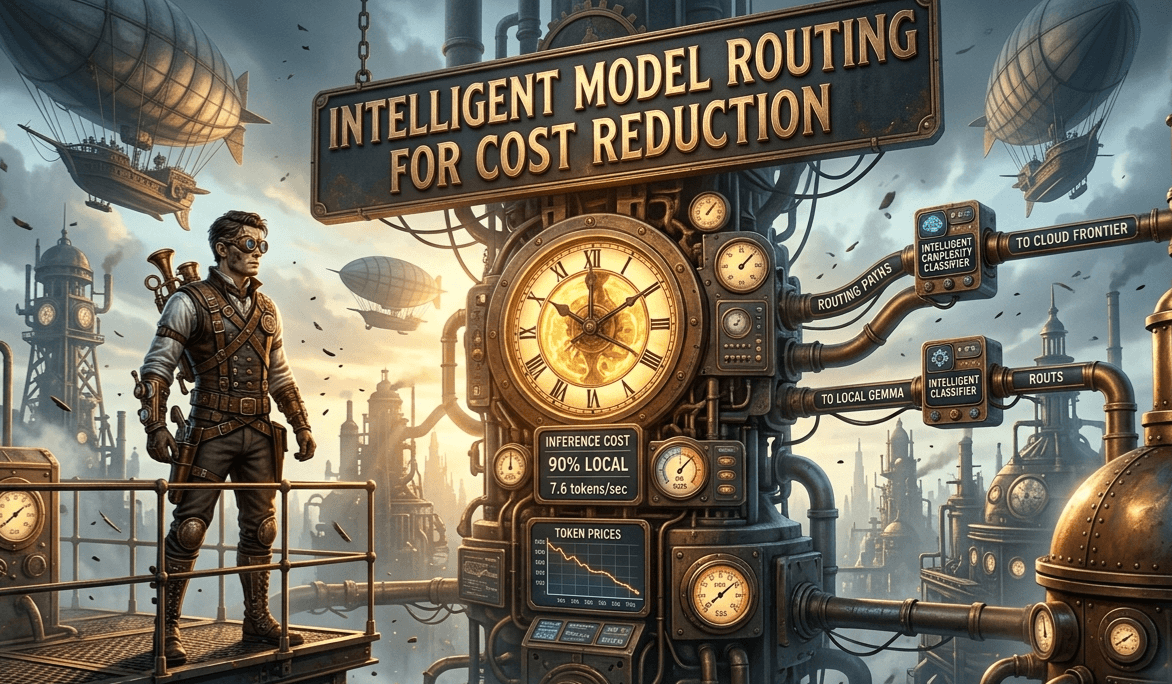
The coding agent era is here. Not in a demo sense. In the sense that engineering teams are running Claude Code, Cursor, and multi-agent frameworks all day, every day, and their inference bills look like they belong to a mid-size SaaS company's entire infrastructure budget.
The tools matured fast. The economics did not keep up.
Single chatbots were expensive but contained. You asked a question, got an answer, the conversation ended. Agentic coding workflows are categorically different. A single developer task like "refactor this module to be async" might involve a planning pass, twenty file reads, eight shell commands, three rounds of linting, two failed compilation attempts, a debugging loop, and a final synthesis. Each of those steps is a model call. Most of them are cognitively trivial. Almost all of them are being routed through the same frontier model you meant to reserve for hard reasoning.
That is where the money goes. And the only fix is thinking about your model portfolio the way you think about an engineering team.
The Inner Loop Is Eating Your Budget
Every agentic coding workflow has two distinct operational layers. Most teams have only thought carefully about one of them.
The outer loop is where the interesting work happens. The orchestrating agent receives a complex task, reasons about the approach, breaks it into subtasks, coordinates specialized subagents, evaluates their outputs, and synthesizes a final result. This is cognitively demanding work. It genuinely benefits from the best model available.
The inner loop is everything else. Reading a file to check whether a function exists. Searching a directory for import statements. Running a grep to find all usages of a method. Validating that a JSON schema is correctly formatted. Monitoring a build output for errors. Generating a commit message. Checking whether a test file already covers a specific function.
These tasks are cheap in cognitive terms. They are extraordinarily expensive in terms of volume. In a typical agentic coding workflow, the inner loop accounts for 80 to 90 percent of all model calls. If you route those calls through Claude Opus 4.7 or GPT-5.5, you are paying frontier compute prices for work that a quantized 2B local model handles identically.
The math compounds fast. An agentic session that costs $4 in model calls if routed intelligently costs $40 if every step hits the same frontier endpoint. At team scale, across dozens of developers running agentic workflows all day, that gap becomes the dominant line item in your infrastructure budget.
Role-Based Routing for Coding Agents
The solution is treating your model portfolio like an engineering organization rather than a single resource you throw everything at.
You would not ask your senior architect to grep through a codebase looking for every instance of a deprecated function. You would not ask an intern to design the entire system architecture from scratch. Engineering organizations work well because people operate at the right level of abstraction for each task. Your model routing strategy should work the same way.
For agentic coding workflows, this maps cleanly to three tiers.
The outer loop orchestrator, the agent responsible for planning the overall approach, deciding which subagents to invoke, evaluating whether the output meets the original requirement, and handling any reasoning that requires genuine strategic thinking, belongs on a heavy frontier model. Claude Opus 4.7, GPT-5.5, Gemini 3.1 Pro, and DeepSeek V4 Pro are all in this tier. This is the expensive hire you use sparingly and only for the work that actually demands it. Heavy reasoning, complex architectural decisions, nuanced code review that needs to catch subtle bugs, synthesis across large codebases.
Implementation belongs on a capable mid-tier model. Claude Sonnet 4.6, GPT-5-Mini, Gemini 3.1 Flash, and DeepSeek V4 Flash are strong options here. This is your most productive tier: capable enough to write solid production-quality code, fast enough to iterate quickly, and reasonably priced enough that multiple implementation passes do not cause anxiety. When the orchestrator hands off a well-defined subtask to an implementation agent, that agent does not need frontier-level reasoning. It needs good code generation and the ability to follow precise instructions.
Background tasks belong on a fast lightweight model or a local deployment. Claude Haiku 4.5, Gemini 3.1 Flash Lite, GPT-5-Mini, Llama 4, and a local Gemma 4 E2B instance all work here. File navigation, directory searches, syntax validation, linting checks, shell command execution, short-form generation like commit messages and docstrings. None of this requires meaningful reasoning capability. It requires speed and throughput. A local model handles this work at near-zero marginal cost, and frequently faster because you eliminate the network round-trip to a cloud endpoint entirely.
claude-code-router Puts This Into Practice
The problem with role-based routing in theory is that actually building it used to require serious infrastructure work. You needed a custom proxy, defined routing logic, fallback handling, and all of it wired together before a single request could be routed intelligently.
The claude-code-router package changes that equation. It is a local proxy that sits between your agentic tools and the model APIs, automatically classifying incoming requests and routing them to the appropriate model tier.
Cheap background tasks like file reads, directory searches, background monitoring, and status checks get routed to local open-source models or budget cloud endpoints. Complex reasoning and implementation work routes to the premium models that justify their cost. The routing logic is fully configurable without touching application code.
Teams using this approach report reducing total AI costs by 8 to 10 times without any degradation in the quality of the core reasoning and code generation that drives actual output. The results hold because the work that matters, planning and implementation, still runs on models that are good at it. You are simply no longer paying Opus prices for grep operations.
What a Real Agentic Session Actually Spends
To understand why the impact is so large, consider what a medium-complexity agentic coding task actually generates in model calls.
A Claude Code session working on a feature might involve: reading the task description and planning the approach, which is one outer loop call that deserves a frontier model like Opus 4.7 or GPT-5.5. Identifying which files are relevant, which is three to five inner loop calls that are fine for a lightweight model or a local deployment. Reading those files, which is five to ten inner loop calls that are fine for a lightweight model or a local deployment. Running searches to understand dependencies, which is four to eight inner loop calls that are fine for a lightweight model or a local deployment. Writing the implementation, which is two to four calls that deserve a mid-tier model like Sonnet 4.6 or GPT-5-Mini. Running and interpreting tests, which is three to five inner loop calls that are fine for a lightweight model or a local deployment. Fixing errors, which is two to three calls that deserve your mid-tier implementation model. And a final review, which is one outer loop call that deserves the frontier model.
In that accounting, inner loop tasks represent around 70 to 80 percent of total calls. Routing all of them to the same frontier model as your planning and implementation steps means paying top-tier prices for the majority of calls that have exactly zero need for top-tier capabilities.
Route the inner loop to a fast local model at near-zero marginal cost. Reserve your mid-tier model for implementation. Keep the frontier model for outer loop coordination only. The cost profile transforms completely without touching output quality.
Enforcing a Hard Budget Ceiling
Role-based routing decides where requests go. It does not automatically enforce what the total workflow spends.
The ParetoBandit approach handles this layer with an online pacer that treats inference budgeting as a strict mathematical constraint rather than a soft guideline. The pacer enforces a per-request cost ceiling and guarantees that the mean per-request cost never exceeds the target by more than 0.4 percent. This is not an approximation. It is a provable bound you can commit to.
For agentic workflows where a single user-initiated task spawns dozens of model calls, this kind of budget enforcement matters. Without it, a single runaway workflow can spike costs far beyond expectations. With it, total cost across the entire call tree is bounded before the first token is generated.
Smarter Classification for Ambiguous Tasks
Not every agentic task falls cleanly into inner loop or outer loop categories. Some requests look cheap but require complex reasoning. Some look complex but are trivially handled by a small model.
For the ambiguous middle, a dedicated complexity estimator adds the precision that role-based rules cannot. The NVIDIA Prompt Task and Complexity Classifier uses a multi-headed DeBERTa architecture that categorizes each prompt across eleven task domains and evaluates six complexity dimensions: required creativity, depth of logical reasoning, domain knowledge requirements, contextual reliance, constraint strictness, and presence of few-shot examples. The output is a weighted complexity score that routes requests with mathematical justification rather than guesswork. The classification overhead adds under 40 milliseconds to the request lifecycle.
For tasks that are genuinely hard to classify before generation begins, the ContextualRouter approach is worth understanding. Instead of a fixed classification model, it maintains a historical database of queries alongside records of how well different models performed on each one. When a new query arrives, it performs a nearest-neighbor semantic search against that database, finds the historically most similar queries, looks at which models performed best on those, and routes accordingly. Adding a new model requires no retraining at all. Add benchmark results to the database and the router immediately considers the new model for future decisions. Research showed these systems generalize to unseen queries using as little as 1 percent of the available historical data.
Semantic Entropy as a Hallucination Detector
For tasks that cannot be reliably classified before generation starts, there is a third approach: measure model confidence during generation rather than predicting it beforehand.
Let the local model attempt the task first. Then monitor whether it actually knows what it is doing. If it exhibits high uncertainty mid-generation, abort and escalate to a cloud model.
Measuring uncertainty is harder than it sounds. Self-reported confidence is essentially meaningless. If you ask a model whether it is confident in its answer, it will say yes regardless. Models hallucinate confidence constantly.
Semantic entropy works differently and functions as a practical hallucination detector for your routing layer. Force the local model to generate multiple responses to the same prompt. Cluster those responses by meaning, deliberately ignoring surface-level wording differences. Two responses that assert the same fact in different words belong to the same cluster. Two responses that assert contradictory facts belong to different clusters.
Compute entropy over the cluster probabilities. If all responses converge on one meaning, entropy is low. The model is consistently producing the same answer regardless of phrasing. That is a signal it knows what it is talking about. If responses scatter across contradictory facts, entropy is high. The model is guessing blindly. Local generation at that point is fabrication dressed as confidence, and the router must escalate.
The STEER framework extends this to the step level, monitoring logit confidence during each reasoning step and invoking the cloud model only when local confidence collapses mid-thought. Benchmarks show a 20 percent accuracy improvement while requiring 48 percent fewer floating-point operations compared to running the large model on every query.
Gemma 4 E2B Is the Inner Loop Engine
All of this inner loop routing needs a capable local model to execute against. The hardware story has genuinely changed.
Google's Gemma 4 E2B runs at 7.6 tokens per second on a standard Raspberry Pi 5 using under 1.5 gigabytes of memory. That is not a benchmark designed to impress in a paper. A $90 single-board computer can serve as a real inference endpoint for inner loop tasks. On a developer laptop with a modern GPU, throughput is substantially higher.
The model runs with 2.3 billion active parameters, supports a 128,000 token context window, and with 4-bit quantization fits into 4 gigabytes of RAM. In benchmark testing it hits 60 percent on MMLU Pro and demonstrates multi-turn reasoning that frequently outperforms larger sibling models on specific tasks.
The 128K context window matters specifically for inner loop tasks in agentic coding workflows. File reads, codebase navigation, and dependency analysis often require ingesting large amounts of context before deciding what to search for next. A local model that truncates input is useless as an inner loop workhorse.
The model is also natively multimodal. Text, images, and audio in the same prompt without external adapters. If your agentic workflow needs to process screenshots of error messages, architecture diagrams, or voice commands, the local model handles that at the edge without streaming anything to a cloud endpoint.
The Memory Wall TurboQuant Removed
There was one remaining practical obstacle to long-context local inference: the key-value cache.
The transformer attention mechanism stores previous token representations in a KV cache that grows linearly with context length. For an 8 billion parameter model at 32,000 tokens of context, that cache alone consumes nearly 5 gigabytes. Traditional quantization tools like GGUF and AWQ compress model weights to 4-bit integers but leave the KV cache in 16-bit float format. The dynamic, continuously growing part of memory stays uncompressed. On consumer hardware, this causes out-of-memory failures before you finish reading a large file.
TurboQuant solves this specifically and without requiring retraining. It intercepts the key and value vectors during real-time inference and compresses them to 3 to 4 bits per element.
The algorithm runs in two stages. PolarQuant applies a random orthogonal rotation to each KV vector to spread energy evenly across dimensions and make the distribution suitable for aggressive quantization. Lloyd-Max scalar quantization then captures the core magnitude and direction in a few bits. A Quantized Johnson-Lindenstrauss transform applied to the residual error with exactly one additional bit eliminates the mathematical bias that extreme quantization introduces into attention score calculations, ensuring the attention math aligns with what uncompressed floats would have produced.
The practical results: 6x reduction in cache memory, 8x speedup in attention computation. A 24 billion parameter model on a consumer 24GB GPU processes 100,000 tokens of continuous context with only 1.8 gigabytes of overhead. Without TurboQuant, that same context causes an immediate hard memory failure. This is what makes Gemma 4 E2B viable as the inner loop engine for agentic coding workflows that read large codebases before deciding what to do.
The Gateway That Holds It Together
LiteLLM handles the gateway layer that makes multi-model routing manageable without turning into a second codebase to maintain.
The core application code never changes after you wire it through LiteLLM. Model assignment for any given task type lives in a JSON configuration file. When you want to upgrade the inner loop model, you update the config. When a new implementation-tier model releases and you want to test it, you update the config. No application rewrites. No coordination across engineering teams to find and update model strings scattered through a codebase.
LiteLLM also handles the reliability layer: load balancing across providers at equal priority, automatic fallback when a primary endpoint fails or hits a context limit, and pre-call context window checks that filter out deployments where the maximum context window is smaller than the incoming payload.
What This Means for How You Build Agents
The shift from chatbot to agentic coding tool is not just a product change. It is a forcing function on infrastructure.
Chatbots are cheap enough that sloppy routing is survivable. Agentic workflows are not. A developer using Claude Code for a full workday generates call volume that would have been considered a moderate production load a year ago. Multiply that by an engineering team. The inference cost structure becomes a first-order engineering concern.
The engineering work of building agentic coding systems has attracted enormous attention. The engineering work of making those systems economically sustainable has attracted much less. That gap is where teams are quietly burning money.
Stop routing grep operations through your frontier model. Assign Opus 4.7, GPT-5.5, or Gemini 3.1 Pro to orchestration. Give the implementation work to Sonnet 4.6, GPT-5-Mini, or DeepSeek V4 Flash. Delegate the inner loop to Haiku 4.5, Gemini 3.1 Flash Lite, Llama 4, or a local Gemma instance. The 8 to 10x cost reduction is not theoretical and does not require sacrificing output quality. It requires routing decisions that reflect what each call actually needs.
Build the routing layer. The money you save on the boring calls is the budget that lets you use the best model without restriction on the calls that actually matter.